Reader setup
Before you choose
List your constraints, required evidence and stop rules before you score options.
- Your own peak agent count and monthly connected minutes, or read-only VICIdial database access to measure them before any sales call — see vicidial-read-only-database-account if you do not have one yet.
- A named owner for the contact-center decision, even if that is only you, who can hold a vendor to written answers instead of a verbal quote.
- Patience for a sales process: multiple sources agree RingCentral does not sell RingCX seats through self-service signup, so a number requires a conversation, not a checkout page.
- What you will prove
- A written list of vendor answers, five contract terms pinned down before signature, and your own measured VICIdial numbers to compare against whatever RingCX eventually quotes.
- Safety boundary
- This article states no RingCX price, no VICIdial total-cost figure and no verdict between the two platforms; it only sets up how to evaluate a quote once RingCentral provides one.
Reader path
How to use this article
- Use it when: You are comparing options and need decision evidence before approval.
- Expected result: Turn options into explicit acceptance criteria and documented stop conditions.
- Start here: Score what is mandatory, keep unknowns visible, then decide only when risks are understood.
Start where the price should be, and is not
Fast answer: RingCentral does not publish a RingCX seat price anywhere this publication could verify, as of 5 August 2026. Two official pages returned HTTP 404 that day — RingCentral's contact-center pricing page and its RingCX product page — and the third-party figures that do circulate for RingCX disagree with each other, including one pairing where the annual rate is quoted higher than the monthly rate, which is backward from how a term discount is supposed to work. Multiple sources agree that RingCentral does not sell RingCX seats through any self-service signup; getting a number means a sales conversation. This article does not print a RingCX price, because none has been verified — instead it treats the missing number as the actual problem: what to ask for in writing, what to pin down before signing, and how to measure your own VICIdial baseline so that whatever quote eventually arrives has something real to be compared against.
That makes this a different kind of comparison than a plan-versus-plan table. RingCX is RingCentral's contact center as a service (CCaaS) product, a hosted subscription an operator rents by the seat or by usage; VICIdial is self-hosted and open source, so an operator runs its own server, owns the carrier relationship and owns its own upgrades instead of paying a monthly seat fee. RingCX also sits inside RingCentral's wider unified communications as a service (UCaaS) portfolio, the hosted phone-and-messaging line the contact-center product is typically sold alongside, which matters to a buyer because a bundled deal can move numbers between products in ways a single-line quote will not show. What follows is a framework for evaluating a quote-only vendor, not a review of RingCX's call-handling features, which this publication has not tested.
In plain language: an agent is the person handling a call, whether logged into the VICIdial agent screen or a RingCX desktop; a campaign is one calling project — which leads get dialed, by which agents, under which dialing settings; a carrier is the phone company that actually carries a call onto the public telephone network, on either platform; a DID (direct inward dial) is a phone number that routes an inbound call into the system; an in-group is the VICIdial routing bucket that hands an inbound DID's calls to a pool of eligible agents, the rough equivalent of a queue on a hosted platform; a disposition is the outcome code an agent saves after a call, such as SALE or NOT INTERESTED.
- Confirm you are reading this because a RingCX quote has not settled a price yet, not because one already has.
- Have your own VICIdial usage numbers ready before the first sales call, not after it.
- Treat every figure below dated 5 August 2026 as perishable; recheck it before relying on it.
Visual walkthrough
Follow three real demo screens
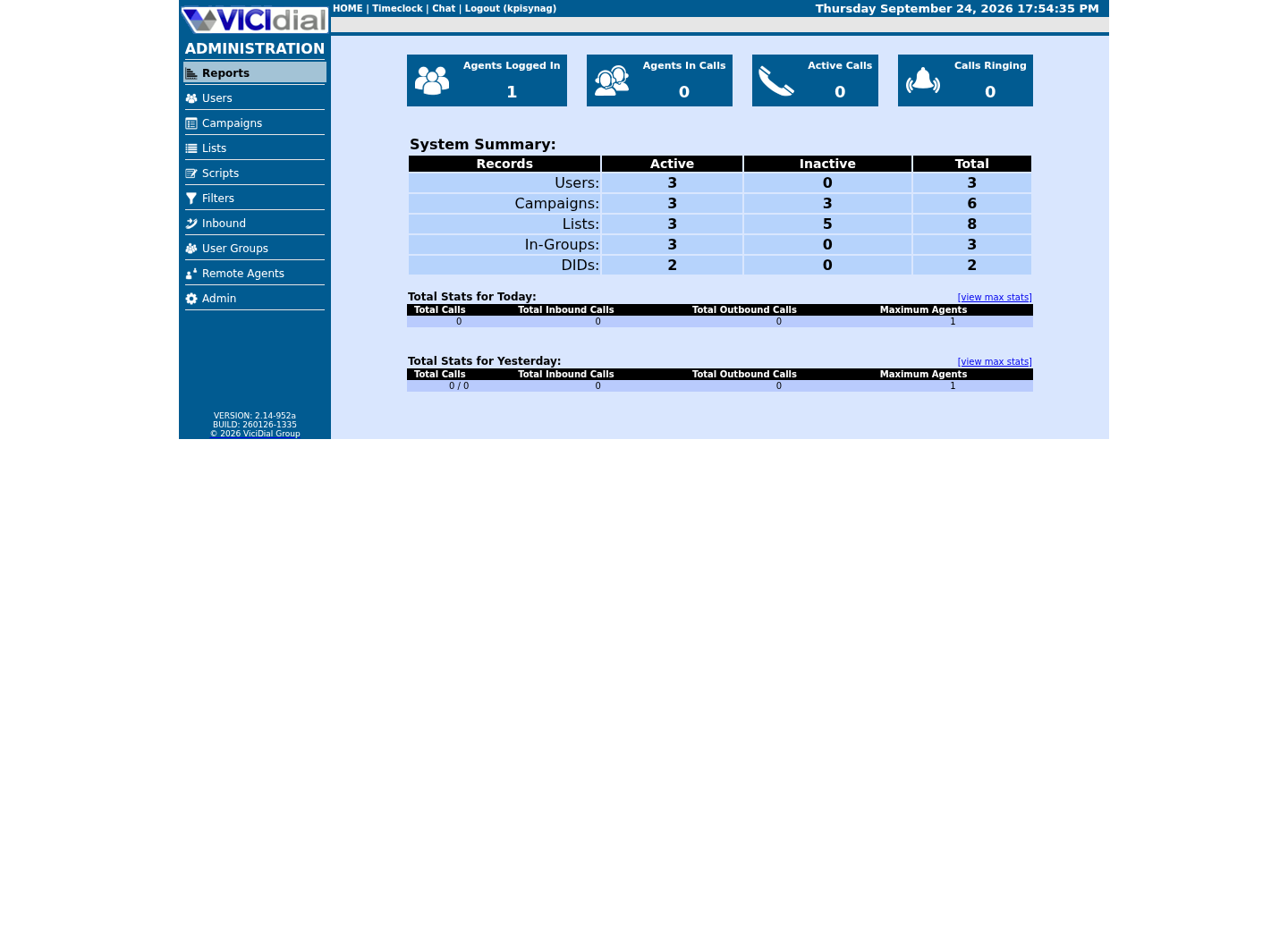
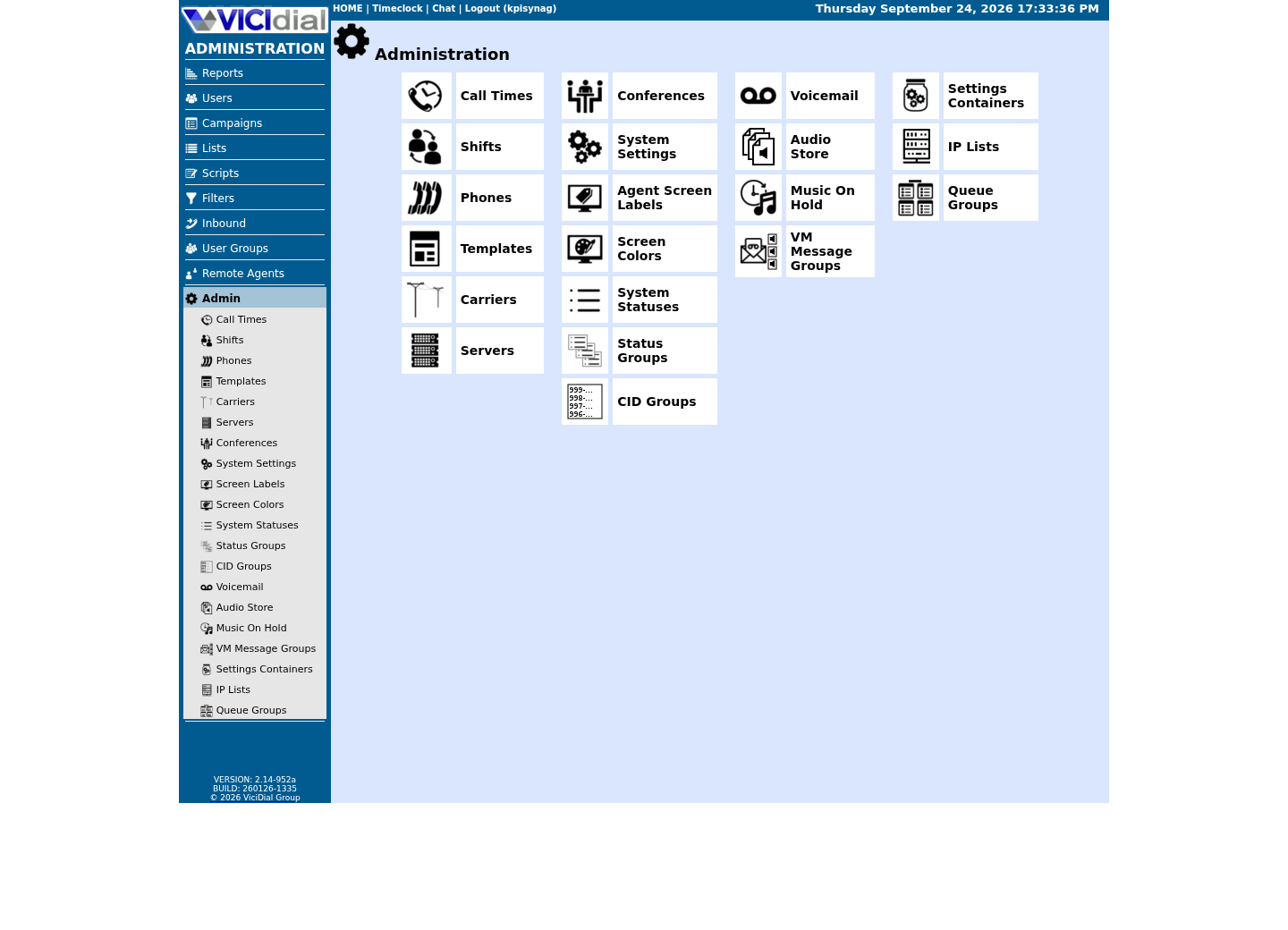
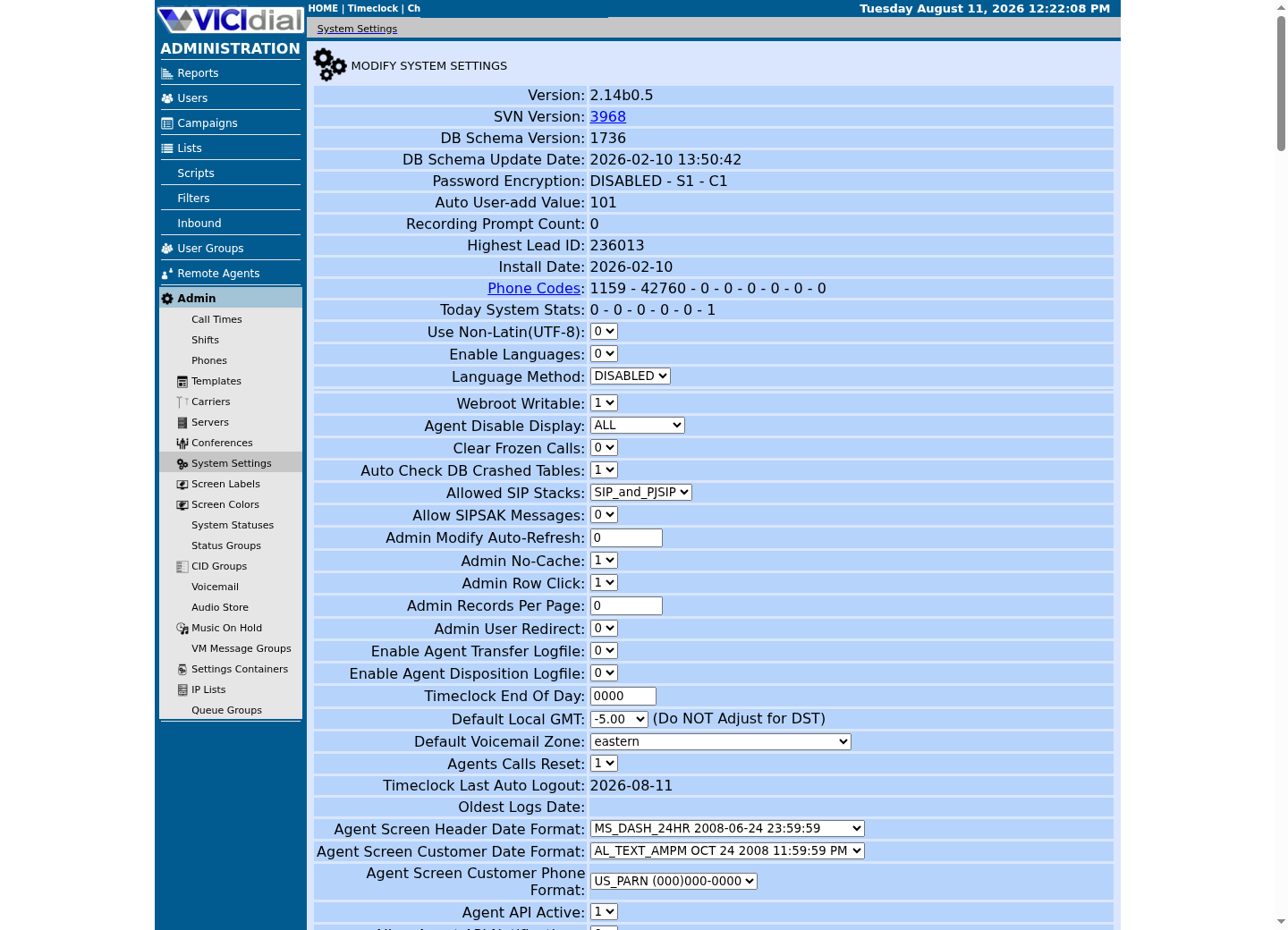
Captured on an isolated VICIdial demo: Administration screens on September 24, 2026, and the idle Agent screen on August 11, 2026. Each caption states its own capture time, and every sanitized image helps you recognize a related screen; none proves that this article's call, command, or result occurred.Start at Administration home
Use the Administration menu as a map
Confirm version and system-wide context
What was checked, and what a published price looks like elsewhere
On 5 August 2026, this publication tried the two most obvious places RingCentral would put a RingCX price: the contact-center pricing page and the RingCX product page itself. Both returned HTTP 404 — the page simply was not there that day, not a login gate or a paywall blocking it. That absence is itself a data point: RingCentral has chosen not to run a public RingCX price page at those addresses, at least not on that date.
In the absence of an official number, a search turns up third-party figures instead, and they do not agree with each other. One source lists a RingCX Professional tier at $95 per user per month billed monthly and $110 per user per month billed annually — an annual commitment is supposed to cost less than paying monthly, not more, so that pairing cannot both be right, and there is no way from outside RingCentral to tell which half, if either, is accurate. Separately, multiple sources agree on one thing: RingCentral does not sell RingCX seats through a self-service signup. Reaching a number requires a sales conversation, which is an ordinary way to sell enterprise software, but it also means two prospects asking about the same seat count are not guaranteed the same starting figure.
Compare that with what a transparent price looks like, verified directly from each vendor's own page and accessed 5 August 2026. Five9 publishes Digital at $119 and Core at $159 per seat per month, states its higher Plus, Pro and Enterprise tiers are quote-only, and discloses a 50-seat minimum up front, so a buyer knows the floor before ever talking to sales. Talkdesk publishes four tiers — Digital Essentials at $85, Voice Essentials at $105, Elite at $165 and its Industry Experience Clouds at $225 per user per month — plus a no-contract Express plan for businesses under 50 employees in the US and Canada. Genesys Cloud CX publishes four tiers, CX 1 through CX 4, from $75 to $240 per user per month billed annually, and states plainly that its named and concurrent licence models cannot be mixed. Amazon Connect breaks the seat model entirely: $0.038 per voice minute, $0.010 per chat message, $0.080 per email and $0.014 per SMS or third-party message, with no seat licensing requirement and no minimum commitment stated — the closest published model to VICIdial's own economics of paying for calls rather than for chairs. None of those four vendors hide their number behind a sales call; as of 5 August 2026, RingCX does.
- Recheck both RingCentral URLs yourself before relying on this article; a 404 today is not a guarantee for next quarter.
- Do not average or split the difference between the conflicting third-party figures; treat both as unverified.
- A published minimum, like Five9's 50 seats, is information a buyer gets for free before a call; a quote-only product asks you to spend a call to get the same information.
Ask every contact-center vendor these questions in writing
Since price is not public, put the burden of specificity on the vendor, in writing, before any verbal number gets treated as real. This applies equally to RingCX and to any other quote-only competitor; the discipline does not change because the vendor's name does.
A verbal quote from a sales call is not the number that ends up on an invoice, and a rate that sounded firm in a meeting can move once it is written into a contract with a term length and a renewal clause attached. This site's own “A 12-point SIP trunk evaluation matrix for VICIdial” scores a carrier's claims as observed, documented, or not tested, rather than taking a sales page at its word; apply the same three-way distinction to a CCaaS vendor's answers. A verbal yes from a sales engineer is documented at best, not observed, until it appears in a contract you can hold them to.
Send the list below to any contact-centre sales contact, RingCentral's or anyone else's, before treating a number as settled. A vendor that will not put answers to all ten in writing has told you something too, even without naming a price.
- Keep the answers attached to the exact seat count and term you asked about; a quote for 50 seats does not bind a quote for 10.
- Route every written answer to procurement or legal, not only to the requesting manager.
- Ask the list again if the quoted seat count, term or bundle changes.
1. What is the exact per-seat price at our quoted seat count and term length, in writing?2. Is that price per named user, per concurrent user, or usage-based per minute or message?3. What is the seat minimum, and does it apply even in a month when fewer seats are active?4. What is the contract length, and what notice period applies before auto-renewal?5. What happens to the per-seat price at renewal — is any increase capped, or left open?6. Which features are bundled in the quoted tier, and which are priced as separate add-ons (AI, quality management, workforce management, analytics)?7. Are telecom or carrier charges billed on top of the seat fee, or included in it?8. Is there a minimum monthly usage commitment, and what happens if actual usage falls short?9. What happens if usage exceeds the bundled minutes or messages, and what is the overage rate?10. What data and configuration can we export if we leave, in what format, and within what window after cancellation?This sample is a template or reading aid, not a terminal command. There is no output to show.
- Before you run it
- Send this exact list to any contact-centre sales contact, RingCentral's or a competitor's, before a verbal number gets treated as a real quote.
- Success looks like
- Every question has a written, dated answer you can hold the vendor to, not a verbal impression from a call.
- Stop if
- Treat an unanswered or verbal-only question as an open risk, not a settled term, and do not sign until it is closed.
Pin down five terms before anyone signs
Five things decide whether a RingCX quote — or any unpublished-price contact-center quote — is comparable to what you run today, or just a photograph of one moment in a negotiation.
The first is the seat minimum. Five9 states its minimum outright, 50 seats, on the pricing page, before a prospect ever picks up the phone. RingCentral states no RingCX minimum anywhere this publication could find; that does not mean one doesn't exist, it means you must ask, and get the answer in writing, before sizing a deal around your actual headcount. The second and third are contract length and what is bundled versus billed separately. A monthly figure without a term length is only half a price: ask whether the quote assumes a one-year, two-year or three-year commitment, since the same per-seat number can imply very different total commitments depending on the term. Ask, too, which capabilities sit inside the quoted tier and which are metered or licensed as add-ons; AI features, quality management, workforce management and advanced analytics are the categories most often sold separately in this market, and a quote naming only a base seat price without addressing these is an incomplete quote.
If a vendor's contract references a service level agreement (SLA), read the exclusions as carefully as the headline commitment; an SLA with a long list of carve-outs and scheduled-maintenance exceptions is a weaker promise than the percentage on the cover page suggests. The fourth term is telecom charges on top of the seat fee — outbound minutes, toll-free numbers, international rates and DID charges are sometimes bundled and sometimes metered separately, and this is exactly the kind of detail a verbal quote glosses over. The fifth is what happens at renewal: does the contract cap a renewal increase, leave it open, or say nothing at all, in which case assume it is open. A renewal clause silent on price protection is not a neutral clause; it hands the vendor the right to set next year's number unilaterally, and it belongs in the negotiation before signature, not after the first renewal notice arrives.
- Keep the filled-in record with procurement, not only in an inbox thread.
- Compare the record against the five terms above before any signature.
- Re-run the check if the seat count, term or bundle changes mid-negotiation.
vendor = [name]quote_date = [date]seat_count_quoted = [number]seat_minimum = [number, or none stated]term_length_months = [number]auto_renewal_notice_days = [number]renewal_price_cap = [stated cap, or none stated]bundled_features = [list]add_on_features_and_price = [list]telecom_charges = [included, or metered with rate]overage_rate = [stated rate, or none stated]export_terms_on_cancellation = [stated terms, or none stated]This sample is a template or reading aid, not a terminal command. There is no output to show.
- Before you run it
- Fill this in only from the vendor's own written quote and contract, after you receive one; every bracket is a placeholder, not an invented figure.
- Success looks like
- Every field has a dated, written answer, or an explicit none stated that you are knowingly accepting.
- Stop if
- Stop and ask again before signing if a required field is blank or answered only verbally.
What a hosted platform would operate for you, and what stays yours
Every CCaaS subscription, RingCX included, is implicitly selling relief from a list of jobs: patching the underlying platform, keeping the telephony stack current, and standing behind it with some form of support. What that list actually contains for RingCX specifically has not been verified here; RingCentral did not publish it on either page this article checked, so treat it as something to request in writing rather than something to assume from category norms.
This site already maps that shared-responsibility split for the self-hosted side. “Managed VICIdial hosting vs self-hosting: a decision framework, not a vendor ranking” walks through who owns operating-system patching, VICIdial and Asterisk changes, certificates, firewall rules, database care, recordings, access review, monitoring and incident response when you run VICIdial yourself versus paying someone else to run it. Ask RingCentral, or any competitor, to answer that same list item by item, in writing; a hosted contact-center product that cannot name who owns each item is not meaningfully different from self-hosting with extra steps in between.
Self-hosted VICIdial keeps direct database and Asterisk access, so a custom report or a new integration is a schema change away rather than a feature request against someone else's roadmap. A hosted platform exposes only what its console and API surface; whatever falls outside that surface is not something a seat price buys you, however the sales deck describes it. Whether that trade matters depends entirely on the integrations and reports your own operation depends on, which is a question only your own workflow list can answer.
- Ask for the ownership list — patching, telephony changes, certificate renewal, monitoring, incident response — for RingCX specifically, not for the CCaaS category in general.
- Confirm which of your current integrations and custom reports would still be possible on a hosted platform before assuming either answer.
- Treat a sales deck's operational claims the same way you treat its price: unverified until it is in writing.
Know your own numbers before the sales call
The only number you fully control in this negotiation is your own. Before a RingCX sales call, or any quote-only vendor's, pull three figures from your own VICIdial database: peak concurrent agents, the busiest hour you actually staff, not your total headcount; monthly connected minutes, the figure a usage-based competitor like Amazon Connect would bill against; and the inbound-versus-outbound split, because some CCaaS tiers price or bundle those differently, and a vendor sizing a quote around outbound-only assumptions will misjudge it if a large share of your volume is inbound.
These numbers do two things. They stop a vendor from anchoring the conversation on a seat count larger than what you actually run at peak, and they give you a second, self-hosted data point — what a VICIdial seat costs today in server and carrier terms — to hold any RingCX number against, even before a published RingCX price exists to start from. Confirm your own schema before trusting any of it: campaign_id and in-group conventions vary between installs, so check the table definitions first and confirm which table and column your own install actually uses for inbound versus outbound before trusting either total.
- Pull these numbers for the same period you will describe to a vendor, not your best month.
- Keep exact caller data and identifiers out of any number you hand to a vendor.
- Refresh the numbers again before signing if months have passed since you first measured them.
SHOW CREATE TABLE vicidial_log; SELECT DATE(call_date) AS call_day, HOUR(call_date) AS call_hour, COUNT(DISTINCT user) AS agents_activeFROM vicidial_logWHERE campaign_id = '<CAMPAIGN_ID>' AND call_date >= DATE_SUB(NOW(), INTERVAL 1 MONTH) AND call_date < NOW()GROUP BY call_day, call_hourORDER BY agents_active DESCLIMIT 10; SELECT DATE_FORMAT(call_date, '%Y-%m') AS call_month, ROUND(SUM(length_in_sec) / 60, 0) AS outbound_connected_minutesFROM vicidial_logWHERE campaign_id = '<CAMPAIGN_ID>' AND call_date >= DATE_SUB(NOW(), INTERVAL 1 MONTH) AND call_date < NOW()GROUP BY call_month; SELECT DATE_FORMAT(call_date, '%Y-%m') AS call_month, ROUND(SUM(length_in_sec) / 60, 0) AS inbound_connected_minutesFROM vicidial_closer_logWHERE campaign_id = '<INGROUP_ID>' AND call_date >= DATE_SUB(NOW(), INTERVAL 1 MONTH) AND call_date < NOW()GROUP BY call_month;This sample changes a system, contacts an outside service, needs a live call, or would print real data from a shared server, so it was not run on the demo. Run it only where you are authorized, and compare the result with the success and stop guidance.
- Before you run it
- Not captured on our lab: its only in-group with traffic carries real calls, so run this on your own in-group. Run with a read-only account, for example mysql --defaults-extra-file=/etc/vicidial-readonly.cnf, against a copy or reporting replica rather than live production during business hours. This lab scopes every statement to one fixture campaign and in-group so it captures safely alongside real traffic; on your own single-tenant install, drop those filters or point them at your own real IDs to get a full total.
- Success looks like
- Each of the three statements returns one number: your peak concurrent agents, your outbound connected minutes, and your inbound minutes for the in-group you name. Together they are the measured inputs a per-seat or per-minute quote has to be priced against.
- Stop if
- If vicidial_closer_log's campaign_id does not hold your in-group IDs on this install, run SHOW CREATE TABLE vicidial_closer_log and adjust the filter before trusting the inbound figure. If your real campaign comes back empty after you substitute its ID, check that calls are actually landing in vicidial_log before trusting any total.
Compare the quote against a baseline you can already measure
None of the five terms or three numbers above matter unless they change what you actually do next, and the choice is not simply RingCX-or-nothing. This site already has a framework built for exactly this kind of comparison. “VICIdial alternatives: an operator test matrix, not a ranking” treats every candidate, including a commercial contact-center suite like RingCX, as something to score against your own operator workflows, evidence quality and migration rehearsal rather than against a vendor's marketing table. Run RingCX through that matrix using the written answers from earlier in this article, and you will have a like-for-like record even before RingCentral names a price.
Whatever a RingCX quote eventually costs, weigh it against a self-hosted number you can already measure. “VICIdial VPS requirements and cost: separate a lab floor from production capacity” builds that self-hosted figure from a pilot and a dated provider quote rather than a guess, deliberately without publishing a single dollar amount, because compute, storage, egress and carrier rates vary too much by region and provider for one number to stay honest anywhere but your own account. That is also why this article states no VICIdial total-cost figure of its own: build it from your measured numbers and a current quote, the same way that guide does.
There is no ranking at the end of this. RingCentral may come back with a number that beats your self-hosted cost easily, or one that does not survive contact with your own peak-hour figures. The only defensible position before that number exists is to have every question from this article answered in writing, all five terms pinned down, and your own usage numbers ready — so that whatever RingCX finally quotes, you are comparing it to something real instead of a guess.
- Do not schedule a cutover, or rule one out, before the written quote and the matrix score both exist.
- Revisit this comparison if RingCentral publishes a price, or if your own peak-agent count changes materially.
- Keep the unanswered-question list from earlier in this article attached to whatever quote eventually arrives.
Evidence ledger
Verification basis
- Checked directly on 5 August 2026: https://www.ringcentral.com/contact-center/ringcx/pricing.html and https://www.ringcentral.com/contact-center/ringcx.html both returned HTTP 404. No RingCX seat price was found on any RingCentral-owned page this publication could locate that day.
- Third-party figures for RingCX conflict with each other, including one pairing that quotes an annual rate higher than a monthly rate for the same tier, which is backward from how term pricing normally works. Neither figure is repeated as fact anywhere in this article.
- Verified by contrast, all read directly from the vendor's own page and accessed 5 August 2026: Five9 publishes a 50-seat minimum with Digital at $119 and Core at $159 per seat per month; Talkdesk publishes four tiers from $85 to $225 per user per month; Genesys Cloud CX publishes four tiers from $75 to $240 per user per month; Amazon Connect publishes per-minute and per-message usage rates with no seat licensing at all.
- No RingCX price, no VICIdial total-cost-of-ownership figure, and no verdict on which platform is better appears anywhere in this article.
Primary references
Sources
- RingCX pricingRingCentral · accessed August 5, 2026
- RingCX contact center overviewRingCentral · accessed August 5, 2026
- Five9 pricingFive9 · accessed August 5, 2026
- Talkdesk pricingTalkdesk · accessed August 5, 2026
- Genesys Cloud CX pricingGenesys · accessed August 5, 2026
- Amazon Connect pricingAmazon Web Services · accessed August 5, 2026