Reader setup
Before you choose
List your constraints, required evidence and stop rules before you score options.
- Your actual peak concurrent agent count, not total headcount, ideally pulled from your own agent-session data
- Your monthly connected call minutes, or a read-only database account to query for them — see vicidial-read-only-database-account if you do not have one yet
- A named owner for the self-hosted box's patching, backups and carrier relationship, even if that owner is you
- What you will prove
- A cost-structure comparison between Talkdesk's published pricing and self-hosted VICIdial, plus the exact queries to fill in your own numbers before either one gets a signature.
- Safety boundary
- Do not compare a Talkdesk quote to a bare server bill; add carrier minutes, numbers, patch and backup time, and staff hours to the self-hosted side before either number means anything.
Reader path
How to use this article
- Use it when: You are comparing options and need decision evidence before approval.
- Expected result: Turn options into explicit acceptance criteria and documented stop conditions.
- Start here: Score what is mandatory, keep unknowns visible, then decide only when risks are understood.
Start with which side of 50 seats you are on
Fast answer: Talkdesk publishes a free Express tier, 25 seats plus a $100 credit, for businesses under 50 employees in the US and Canada, with no contract required, as stated on its own pricing page on August 5, 2026. Five9, by its own pricing page read the same day, will not sell below 50 seats at all. On the one axis both vendors actually publish, minimum size, they sit at opposite ends of the same question, and a small VICIdial operator who has been told cloud contact-center software is not built for their size may find that only one of these two vendors agrees. Neither fact makes either vendor better; it only decides which comparison is even live for a given reader.
This article does not total either side into one number, rank Talkdesk against Five9 or any other vendor, or assert a feature that Talkdesk's own page does not itself state. Every price below is dated to August 5, 2026 and will move; recheck it before acting on it. What follows is the cost structure on both sides of a seat-price line, and the two numbers from your own VICIdial database, peak concurrent agents and monthly connected minutes, that turn a published price into a comparison instead of a guess.
In plain language: an agent is the person logged into the VICIdial agent screen taking calls; a campaign is one calling project, meaning which leads get dialed, by which agents, under which dialing settings; a carrier is the phone company that carries your calls to the public telephone network; a DID is a phone number that routes inbound calls into your system; a disposition is the outcome code an agent saves after a call, such as SALE or NOT INTERESTED; and a lead is one contact record, a phone number plus its call history.
- Prerequisite: your own peak concurrent agent count and monthly connected minutes, not a headcount guess or a sales estimate.
- This is a cost-structure comparison, not a vendor ranking, a feature audit or a signed recommendation.
- Every price cited here is dated to August 5, 2026; confirm current terms with the vendor before committing to anything.
Visual walkthrough
Follow three real demo screens
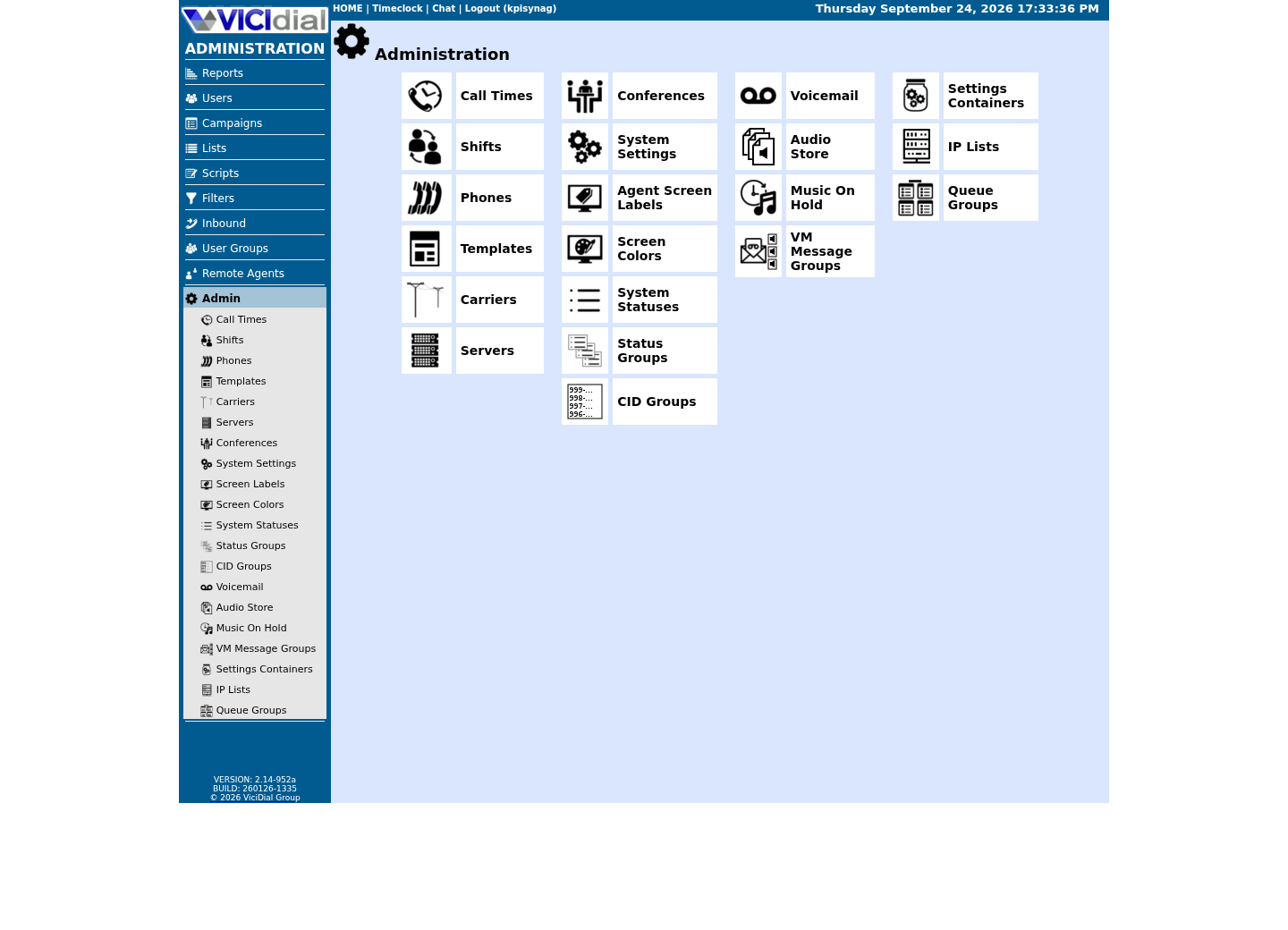
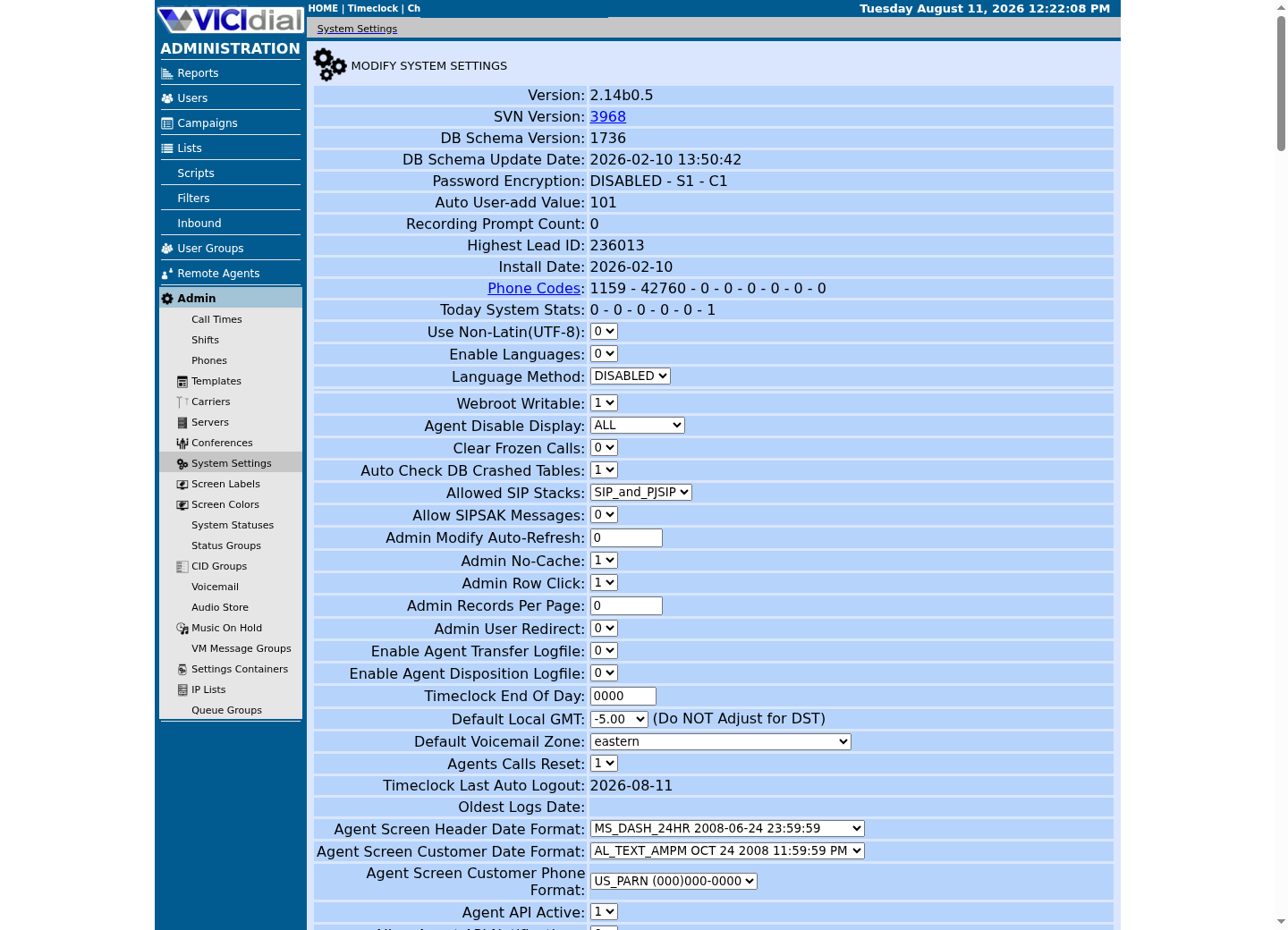
Captured on an isolated VICIdial demo: Administration screens on September 24, 2026, and the idle Agent screen on August 11, 2026. Each caption states its own capture time, and every sanitized image helps you recognize a related screen; none proves that this article's call, command, or result occurred.Start at Administration home
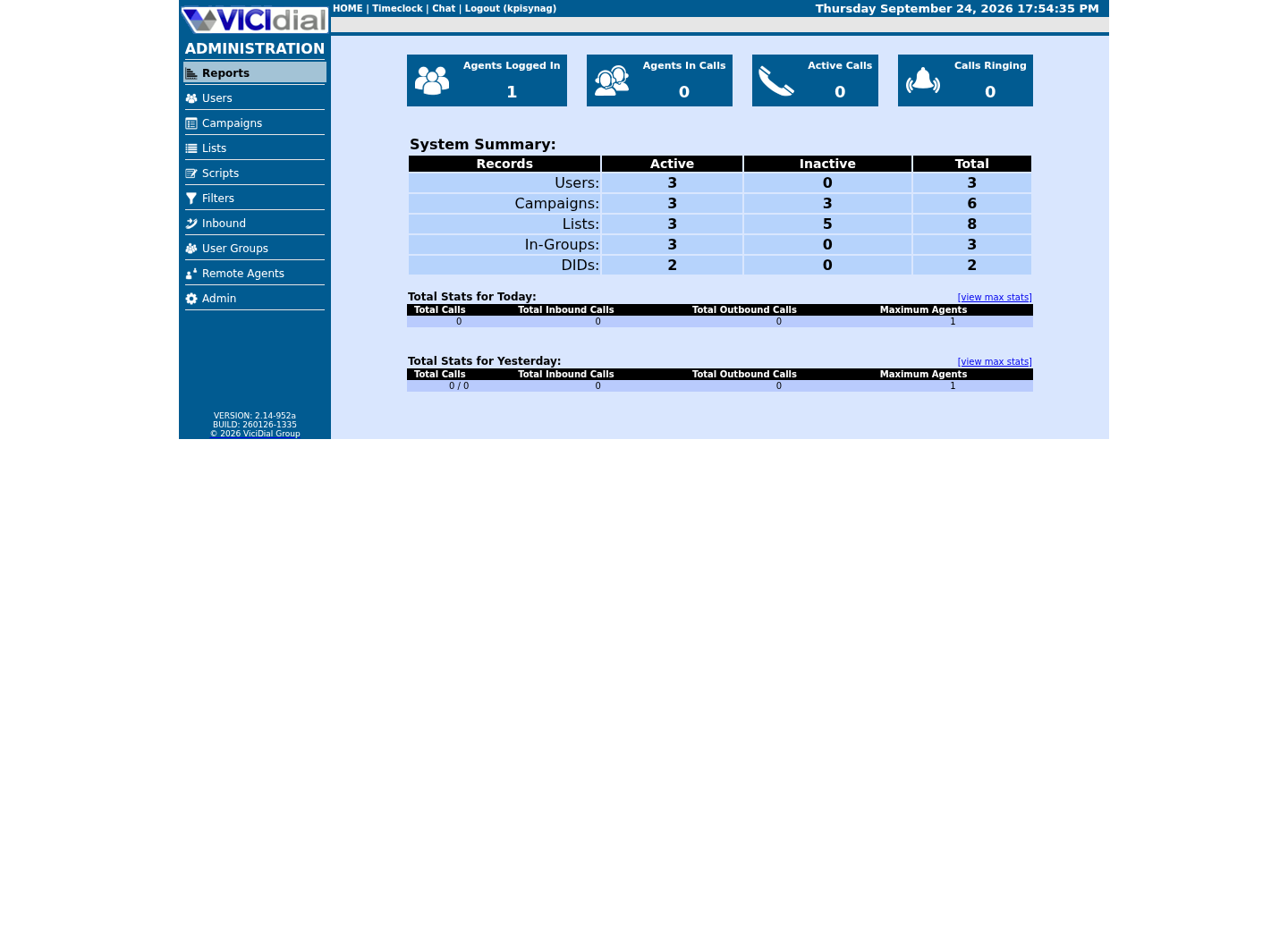
Use the Administration menu as a map
Confirm version and system-wide context
Talkdesk's free tier and Five9's seat floor sit at opposite ends of one question
Talkdesk Express is a free trial: 25 seats plus a $100 credit, open to businesses under 50 employees, with no contract required, restricted to the US and Canada, as published on Talkdesk's own pricing page on August 5, 2026. Five9's pricing page, read the same day, states a minimum of 50 seats across its tiers, with no equivalent free or small-business entry point published anywhere on that page.
That means a five-agent VICIdial shop evaluating cloud alternatives gets two different answers depending only on which vendor it calls first: one has a published, no-cost way to try 25 seats today, and the other will not take the call below 50. Neither position is a judgment on the underlying platforms; it is a published fact about who each vendor has decided to sell to at this size, and it is worth knowing before a sales conversation starts, not after.
The size question runs the other direction too. Talkdesk Express is explicitly scoped to businesses under 50 employees, and the page does not state what happens at 51, whether the trial converts automatically, or what it converts to. A VICIdial operator that is small today but plans to grow past that line should ask Talkdesk directly, because the pricing page does not answer it.
- Confirm your own current employee count against the under-50 test before assuming Express eligibility.
- Ask what happens to an Express account once headcount crosses 50; the page does not say.
What Talkdesk's pricing page states, verbatim, as of August 5, 2026
Talkdesk's own pricing page lists four paid, per-user tiers: Digital Essentials at $85 per user per month, Voice Essentials at $105, Elite at $165, and Industry Experience Clouds at $225. Government pricing is listed as custom, with no figure published. Every one of those figures is per user per month in US dollars; the page does not state whether it is billed monthly or annually, and it does not break voice usage, phone numbers or support out as separate line items.
The page also does not publish a minimum seat count or a contract length for any of the four paid tiers, only for Express. Third-party sites report a mandatory 36-month contract for Talkdesk; Talkdesk's own page states no such term, so this article does not repeat that figure. If contract length matters to your decision, and it should, the page simply does not answer it: ask during the sales conversation and get the term in writing before comparing it to anything self-hosted.
Five9's own pricing page, for the comparison that opened this article, lists Digital at $119 per seat per month and Core at $159, with Plus, Pro and Enterprise listed as quote-only, plus the published 50-seat minimum and a note that usage-based pricing may apply to certain features. Neither company's page states what that usage-based pricing actually covers, which is the same gap Talkdesk's page leaves open.
What a per-seat price replaces, and what it does not
A published per-seat price is doing real work: it typically bundles the platform itself, a license to the features in that tier, and, for every vendor read for this article, a listed support tier. That is a genuine simplification compared with assembling the same thing yourself, and it is the honest case for a per-seat quote.
It is also, by definition, a price for seats, not for calls. None of the vendor pricing pages read for this article states, on the page itself, whether carrier or voice-usage minutes are included in the per-seat price or billed separately, what a phone number or DID costs, or what the minimum seat count and contract length are outside Talkdesk Express. Amazon Connect's own pricing page is the one exception among vendors checked here: it states plainly that there is no seat-based licensing at all, and prices voice by the minute instead. That is a different model, not a missing detail, and it is worth naming as the published structure closest to how VICIdial itself is actually billed: by the call, not by the chair.
And no vendor's per-seat price, on any page read for this article, claims to include the time your own staff spends building campaigns and scripts, administering users and reporting, or simply managing the change itself. That labor is real on the cloud side of this comparison too; it is only larger and more visible on the self-hosted side, which the next section walks through.
PRICED BY THE PUBLISHED PER-SEAT RATE:platform_and_feature_tier = includedlisted_support_tier = included NOT STATED EITHER WAY ON THE PRICING PAGE, CONFIRM BEFORE YOU COMPARE:carrier_or_voice_usage_minutes = ask salesphone_number_or_DID_fees = ask salesminimum_seat_count_outside_express = ask salescontract_length = ask sales NEVER PART OF ANY VENDOR'S SEAT PRICE, EITHER SIDE OF THIS COMPARISON:staff_time_to_build_campaigns_and_scripts = separatestaff_time_to_administer_users_and_reporting = separatestaff_time_to_manage_the_change_itself = separateThis sample is a template or reading aid, not a terminal command. There is no output to show.
- Before you run it
- Fill in the middle block from a dated sales quote before treating any per-seat figure as comparable to a self-hosted number.
- Success looks like
- Every line in the middle block has a dated answer from the vendor, and the bottom block carries named hours instead of an assumed zero.
- Stop if
- Stop comparing prices if the middle block is still marked ask sales while a decision is being made anyway.
What self-hosting costs that never shows up as a seat line
Self-hosted VICIdial has no per-seat license at all; the software itself is open source. That is the headline of the self-hosted side and also the reason its costs are less visible: they show up as a server bill, a carrier contract and staff time instead of one line on a vendor invoice. VICIdial VPS requirements and cost: separate a lab floor from production capacity works through the compute side of that bill in detail, including why a documented lab-sized node is not evidence of what a production node actually costs.
Compute is not the only line. Someone owns operating-system patching, VICIdial and Asterisk upgrades, certificate renewal, firewall rules, database care, backups and the restore drill that proves they work, access review and incident response, whether that someone is an employee, a contractor or the same person running the business. Managed VICIdial hosting vs self-hosting: a decision framework, not a vendor ranking sets out how to assign and evidence each of those controls before comparing a managed quote to a self-hosted one; the same list applies here, against a cloud contact-center quote instead of a managed-hosting quote.
Capacity has a checkable ceiling too, but the number that tells you where you actually sit against Talkdesk Express's 25-seat, under-50-employee line is your own roster, not a port count: how many distinct agents your installation actually logged in the past month. Pull that figure directly rather than estimating it from a headcount spreadsheet.
Once that roster count is closing in on 25 seats, or on the under-50-employee line itself, the next step is not a bigger box but a cluster: Scaling VICIdial: designing a multi-server cluster for 500+ agents lays out the roles and shared state that splitting across servers requires, which is the self-hosted answer to the same growth that pushes a cloud buyer past Five9's 50-seat floor or Talkdesk Express's under-50-employee limit.
SELECT COUNT(DISTINCT user) AS distinct_agents_last_30_daysFROM vicidial_logWHERE campaign_id = '<CAMPAIGN_ID>' AND call_date >= DATE_SUB(NOW(), INTERVAL 30 DAY);Captured demo response · 2026-09-24 22:25 UTC. The displayed command is the command that ran; a safe subset label means it was filtered, redacted, or fixture-scoped. Replays only after you select Replay transcript.
- Before you run it
- Run this with a read-only account, mysql --defaults-extra-file=/etc/vicidial-readonly.cnf, over a full 30-day window; a shorter window can understate a roster that rotates shifts. This lab scopes the query to one fixture campaign for a safe capture; point it at your own real campaign to size your own roster.
- Success looks like
- distinct_agents_last_30_days tells you where your own operation actually sits against Talkdesk Express's 25-seat limit and the under-50-employee test, instead of a guess from an org chart.
- Stop if
- If the count looks off, check for shared logins or a campaign filter narrower than your real operation before treating the figure as final.
Measure your own peak concurrency and connected minutes before pricing anything
A per-seat quote multiplies its price by however many agents are logged in at once, not by your total headcount; a usage-based quote, like Amazon Connect's published per-minute model, multiplies by connected minutes, not by calls dialed. Both numbers already live in your own VICIdial database if you are running it today, and both are worth pulling before any vendor conversation, cloud or self-hosted, gets specific.
The query below approximates peak concurrent agents by counting distinct users who placed or received a call inside the same hour, across a rolling 30-day window; it is a proxy, not an exact overlap calculation, so treat the top few hours as a range rather than a single figure. The second statement sums connected seconds from both the outbound and inbound call logs over the same window and converts them to minutes.
Neither number alone settles anything. A shop whose peak concurrency sits at 22 agents is inside Talkdesk Express's 25-seat limit and well under Five9's 50-seat floor; one whose peak sits at 60 has already outgrown Express and is a normal Five9 conversation. Run the query against your own data before assuming which side of either line you are on.
- Run this over a full 30-day window, not a single busy day, so a seasonal peak does not distort the seat count you plan around.
- Treat the hour-bucket count as a proxy for peak concurrency, not an exact simultaneous-login figure.
- Recompute after any campaign, staffing or hours-of-operation change; last quarter's peak is not this quarter's.
SELECT DATE_FORMAT(call_date, '%Y-%m-%d %H:00') AS hour_bucket, COUNT(DISTINCT user) AS agents_active_this_hourFROM vicidial_logWHERE campaign_id = '<CAMPAIGN_ID>' AND call_date >= DATE_SUB(NOW(), INTERVAL 1 MONTH) AND call_date < NOW()GROUP BY hour_bucketORDER BY agents_active_this_hour DESCLIMIT 5; SELECT ROUND(SUM(length_in_sec) / 60, 1) AS connected_minutesFROM ( SELECT length_in_sec FROM vicidial_log WHERE campaign_id = '<CAMPAIGN_ID>' AND call_date >= DATE_SUB(NOW(), INTERVAL 1 MONTH) AND call_date < NOW() AND length_in_sec > 0 UNION ALL SELECT length_in_sec FROM vicidial_closer_log WHERE campaign_id = '<INGROUP_ID>' AND call_date >= DATE_SUB(NOW(), INTERVAL 1 MONTH) AND call_date < NOW() AND length_in_sec > 0) connected_calls;This sample changes a system, contacts an outside service, needs a live call, or would print real data from a shared server, so it was not run on the demo. Run it only where you are authorized, and compare the result with the success and stop guidance.
- Before you run it
- Not captured on our lab: its only in-group with traffic carries real calls, so run this on your own in-group. Run both statements with mysql --defaults-extra-file=/etc/vicidial-readonly.cnf against a rolling 30-day window; a shorter window understates both numbers. This lab scopes each statement to one fixture campaign or in-group for a safe capture; on your own install, point the filters at your own real IDs instead.
- Success looks like
- The top hour_bucket row gives a defensible peak-seat count, and connected_minutes gives the figure a usage-based quote should be measured against.
- Stop if
- Stop and fix the date range or check for gaps in event_time/call_date coverage before quoting either number to a vendor.
What to ask before you compare a quote to a server bill
Neither side of this comparison is complete from a pricing page alone. Talkdesk's page does not state a minimum seat count or contract length outside Express, and does not say whether carrier usage or numbers are bundled into the per-seat price; get all four in writing before comparing them to anything. Five9's page states its 50-seat floor plainly but is equally silent on what its usage-based add-ons cover.
On the self-hosted side, the open question is never the software license, since there is none, but who is actually named against each operational control. VICIdial alternatives: an operator test matrix, not a ranking sets out the same kind of structured evaluation for choosing among self-hosted, managed and cloud options generally, and is the place to go once this article's cost structure needs to become an actual scored comparison across named candidates.
This article does not total either side or pick a winner between Talkdesk, Five9 and self-hosted VICIdial. It gives you the structure and the two numbers, peak concurrent agents and monthly connected minutes, that make the comparison specific to your own operation rather than to a vendor's marketing page or a competitor's blog post.
- Get Talkdesk's minimum seat count and contract length in writing; its pricing page states neither.
- Get written confirmation of what is and is not bundled into any per-seat price before comparing it to a server bill.
- Re-run the peak-concurrency and connected-minutes query after any material change in staffing or campaign volume.
Evidence ledger
Verification basis
- Every Talkdesk and Five9 figure in this article was read directly from that vendor's own pricing page on August 5, 2026, not from a reseller, review site or aggregator.
- Talkdesk's minimum seat count and contract length are not published on its pricing page; this article does not assert either figure, including the frequently repeated 36-month contract claim.
- No total-cost-of-ownership figure is calculated for either side; hosting, carrier rates and staffing vary too much per operator for one number to be honest here.
- The distinct-agent and connected-minute queries in this article read only vicidial_log and vicidial_closer_log, scoped to this lab's own fixture campaign and in-group; no per-box audio-channel ceiling is asserted anywhere in this article.
Primary references
Sources
- Talkdesk pricingTalkdesk · accessed August 5, 2026
- Five9 pricingFive9 · accessed August 5, 2026
- VICIdial product overviewVICIdial · accessed August 5, 2026